Blog

Dragons are everywhere

Dragons seem to be everywhere at the moment. This is today’s Google doodle, celebrating the red dragon of Wales. There are many legends about it. One says that the villagers near its cave were frightened of the dragon until St David befriended it – it turned out to be vegetarian.

Another legend says that the red dragon saved the villagers from an ice dragon that was terrorising them. After the battle the red dragon returned to its cave to hibernate, and has not been seen since.

The Green Dragon on a Chinese tile. Photo credit: 沃德利成書畫院

In China dragons are always auspicious. The green dragon (qīng lóng) even has a constellation named after it. This constellation rises in the Eastern sky in the springtime (the dragon “raises its head”), signalling, or perhaps even bringing the spring. For anyone living in one of the big coastal cities on the east coast, the dragon would thus emerge from the waters of the East China Sea.

The Taoist arts are full of references to dragons; in Taiji sword there is a beautiful move called 青龍現水 “Green Dragon Appears on the Water”, whilst in the Lok Hup set there is even a move called 蟄龍現身 “Hibernating Dragon Shows Body” (Chinese dragons hibernate just like Welsh ones). Dragon energy is about lengthening the spine, often with a coiling motion; typically the head is lifted up.

Do the Taoist arts have references to red dragons also? They do. One of the last moves of the Lok Hup set is called 赤 龍 攪 水 “Red Dragon Stirs Waters”. It was Mr Moy’s favourite move: a smile always appeared on his face when he played this move.

Needle at Sea Bottom

What is the meaning of this movement – what would a Chinese person understand by its name? The word ‘needle’ might remind them of the legend of the Monkey King, who for a weapon used a magical iron pillar, twenty feet long, that he could shrink to the size of a needle and tuck behind his ear. This iron pillar, the legend says, was used by Great Yu to “fathom and fix” the depth of the rivers and seas when he brought the Yellow River under control (the river used to flood repeatedly). This is an historical event that took place 4000 years ago; the Chinese refer to it as Great Yu Controls the Waters (大禹治水 dà yǔ zhì shuǐ). This magical weapon was found for Monkey by the Dragon King and Queen, who lived at the bottom of the sea.

But perhaps we are pushing a needle to the bottom of the sea, rather than picking one up? This may be the correct explanation, but the sea may not be where we first think it is.

In this view the sea would refer to the ‘sea of qi’ 氣 海 qì hǎi, in other words the lower dan-tien (the energy centre in the belly). There’s even an acupuncture point here with this name (CV6). The bottom of this sea 海 底 is not the seabed, but the pelvic floor. Martially, it seems that the move was originally used to attack the cavity between the hip and the groin. If the strike was not sufficient to disable the opponent, one continued downwards in order to push the opponent to the ground.

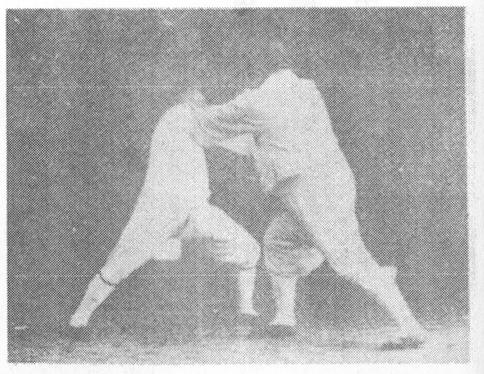
Yang Cheng-fu demonstrates “Needle at Sea Bottom” (1931)

Here is Yang Cheng-fu demonstrating Needle at Sea Bottom in his book The Essence and Applications of Taijiquan. Yang describes using the movement to break free from a grab of one’s right wrist at the end of the previous ‘Brush Knee’. The opponent is pulled first towards you and then down, uprooting him. “The movement’s intent is like a needle probing the bottom of the sea”. There is no mention of striking with the hand, but we should remember that the book was written and published quite late in the development of Tai Chi: in 1931. By this time several movements had lost their original purpose; a classic example is White Snake Shoots out Tongue, whose original meaning was only preserved in oral transmission.

The way Mr Moy performed Needle at Sea Bottom himself was similar, although with a narrower base so that the weight remained in the back foot. However the way he taught it was a bit different. To beginner and intermediate students he showed a table stretch with straight legs, designed to stretch not just the legs, but the back and spine:

Needle at Sea Bottom – a table stretch.

The coccyx stretches back and the head forwards, lengthening the spine. Additionally there is a rounding across the shoulder blades and across the back of the pelvis.

To students who were more flexible Mr Moy taught the version he himself performed in which he allowed both knees to bend. This clearly won’t stretch the tendons in the leg, but it creates more stretch across the back of the pelvis, opening the sacro-iliac joints.

Remembering that Tai Chi is an “internal” art (內家 nèi jiā), one further possibility comes to mind: perhaps the sea here is neither a figurative ocean, nor the ‘sea of qi’ of an opponent, but the one inside ourselves?

Further references

  1. Jim McClanahan: The Magic Powers of the Monkey King’s Iron Staff
  2. Sara Olsen: Needle at Sea Bottom

The five animal forms

Sometimes in Taiji we hear talk of the Five Animal Forms and the Eight Animal Appearances. What does this mean?

The animal appearances are attempts to mimic aspects of an animal’s movement, for example, the rounded back of a bear. An old example of this is the 五禽戲 Wu Qin Xi or Five Animal Frolics, said to have been created by Hua Tuo during the Eastern Han Dynasty (25-220). This qi-gong sequence is still popular today.

Mr Moy brought with him a later system which spoke of eight animal appearances and five animal forms. What are the forms? These are attempts not to mimic the movement of an animal, but to embody one of its qualities, such as balance. Talk of the Five Animals in Chinese martial arts is not confined to Taiji or the Taoist arts. The place one most often hears them mentioned is in Shaolin Kung-fu. But Kung-fu and Taiji both work with the same five animals: the tiger, the leopard, the crane, the dragon and the snake. The term used in Chinese is wǔ xíng 五 形 which means five forms.

The first animal is the tiger 虎 hǔ. Tiger stands for the strength of the bones, and in this regard we should remember that healthy bones are flexible. In Taiji the tiger particularly references the pelvis, and the opening of the pelvic bowl.

The second animal is the leopard 豹 bào. The leopard pounces on its prey, sometimes springing from trees. This requires springiness in the tendons: the leopard stands for the elasticity of the tendons. The tendons rest on the bones – the first animal.

The third animal is the crane 鹤 hè. The crane has balance and stillness. It conserves energy. Its long limbs, like those of the gibbon, enable it to “gather” more qi, because long limbs lead to a greater separation of ying and yang.

The fourth animal is the dragon 蜻 lóng. The dragon embodies presence and clarity; its movements are majestic. It stands for the lengthening of the spine. It is vertical. In taiji, it references the don-yu, which is sometimes called the dragon squat, and the circulation of energy along the mid-line.

The fifth animal is the snake 蛇 shé. The snake stands for flow. It especially manifests in the snaking of the spine.

The order of the animals is significant. In taoism the animals are trained from yang to yin. The tiger is the most yang, and is trained first; the snake is the most yin and the most difficult, and is trained last [1].

Eliot Kravitz MD, who worked for many years alongside Mr Moy, points out that all animals are present simultaneously. In Chinese culture, this is implicit in the term wǔ xíng, which has two different meanings. Here it is 五 形, the five (animal) forms, but it could also be 五 行, often translated in the West as the Five Elements (because it reminded us of the Four Western Elements). In Chinese it’s often hard to tell if a character represents a noun (a state) or a verb (an action). Translations which emphasise the latter are the Five Agents or the Five Processes; a compromise translation is the Five Phases.

Credits:
[1] 5 animals, 5 elements on shaolinwingchun.com
[2] images: Shaolin Wahnam Institute, Vienna
Carry tiger to mountain

What on earth can the name of this movement mean? The names of the movements are recorded at least as early as 1931, when they appear in Yang Cheng-Fu’s book “Applications of Taijiquan“. The Chinese characters 抱虎归山 Bào hǔ guī shān literally say: “Embrace tiger, return (to) mountain”. The tiger is a fierce animal: powerful and dangerous. The mountain is its home. Here the tiger stands for a fierce opponent who is sent back whence they came, but what is the carrying/embracing about? The name has confused many, with some even speculating that bào might actually stand for its honomyn 抱, which means leopard. There’s no evidence for this at all, and it’s not the character in Yang Cheng-Fu’s book (although this would have been dictated to a senior student).

I searched the internet for 抱虎归山 and discovered this scroll by the Chinese artist Zhang Shan-Zi. The scroll dates from 1925, which is before Yang Cheng-Fu wrote his books. Zhang made many tiger scrolls including one bearing as its title the famous Chinese phrase “Crouching Tiger, Hidden Dragon”.

The image makes clear the meaning of “embracing”, but is otherwise a bit of a red herring. The tiger tightly hugs a boulder on a steep mountain side to avoid falling. As Sun-Tzu wrote in ‘The Art of War’ (5th century BCE): “Keep your friends close; keep your enemies closer”. In the Tai-ji movement, the tiger is the enemy.

How does this relate to the mechanics of the movement? First of all, remember that “Cross hands” is a separate movement: when we cross hands, we are not really carrying the tiger, even if this is a handy aide-mémoire. Yang Cheng-Fu’s book says: “From the previous movement (Cross Hands), presume the opponent closes on me from behind at the right corner”. If the opponent is close, then the movement that follows is a trip. The right leg is picked up and placed behind the opponent’s leg. Then we push him back and trip him over.

How is this like “embracing a tiger”? The answer comes when we look at Yang style Tai-ji. In Yang style, when we step to the corner the left hand falls and the right hand rises. Yang Cheng-fu describes two applications for this movement in his book. If the opponent attempts a strike with their right hand (or foot), then the raised right forearm wraps the attacking limb. Then the left hand pushes them over. See the picture below.

Yang Cheng-Fu demonstrates one application of “Embrace Tiger” – although sadly not the one which gives the movement its name – blocking a right punch with the right forearm before striking with the left palm. From “Applications of Taijiquan”, 1931.

So far, so good, but we still have not ’embraced’ our opponent. Yang Cheng-Fu describes another application: if the opponent attacks with their left hand then after the block the (raised) right hand circles round the back of the opponent. We hug them close, with a movement that some have described as like scooping up a child, before the left hand, continuing forward, knocks them over with a push to the face or shoulder.

In the meantime, after generations of oral transmission and evolution have obscured the meanings of the movements, it does no harm to imagine that when we cross hands, we embrace a tiger.

Relax and let go

Mr Moy, like many Tai ji teachers, told his students to relax. What he actually said was fang sōng – 放 松.

Perfectly relaxed: a pine tree.

Sōng 松 is an essential quality for tai chi practitioners. It means loose, but the character also means a pine tree. You can see the pictographic representation of a tree in the left hand half of the character, with branches hanging down from the trunk – this is more clear in an older version of the character 枩 which has more branches. The branches hang loosely, but the tree retains its structure – something that is no longer implied by the word “relax” in English, which today could easily refer to someone collapsed on their sofa, with no structure.

Fang 放 means release. Fang sōng thus means something like “let go of all excess tension”.

Towards the end of his life, Mr Moy started telling his students, in English, to let go, a translation of fang sōng which avoids the ambiguity of the word relax. I like to think of it as: relax and let go.

Wild horse parts mane

The name of this move puzzled me for years. 野马分鬃 – Wild horse parts mane – what does it mean?

In English this move is sometimes called Parting wild horse’s mane. This rendering leads on to the idea that the tai chi player is parting the mane of a wild horse. This always seemed a bit unlikely to me. Wild horses are, well, wild. In Taoism, the wild horse is a metaphor for the raw energy of our physical body, the energy of youth. Think of the movement in the Lok Hup set Wild horse chases wind, whose name describes how we so easily waste our energy on useless projects. The energy must be brought under control, but the idea that we will get a comb out and part the mane of a wild horse – really?

Chinese is rather terse as a language and frequently dispenses with things such as articles (a, the) and possessive pronouns (his, hers, its). It’s very tempting to add extra words to make nice English phrases, but these are not English phrases – they are Chinese. 🙂 Here the Chinese simply says, literally, wild horse parts mane. So who is doing the parting?

My answer came to me one day watching a nature documentary about mustangs, the wild horses of the North American plains. In this documentary there was some slow-motion footage of a running horse which, as its ran, was shaking its head. The slow motion footage revealed how this sent a rippling motion down the animal’s neck.

Suddenly it all became clear. As we perform Wild horse parts mane to right and left, we are the horse, shaking our mane – our neck and spine – from side to side. In the video, look at the way a wave ripples along the horse’s neck as it shakes its mane.

Repulsing the monkey

攆 猴 Repulse monkey is one of the repeated moves in the Tai Ji set. Why do we repulse the monkey? The simplest explanation is that to calm the mind, we must repulse or expel (攆) the chattering monkey mind.

This makes sense, but perhaps there’s more to it than this. As ever, the question to ask is: What would a Chinese person understand by the name of this move?

Monkey was a cheeky Chinese demi-god. He got up to all kinds of mischief, but the exploit that the Chinese best remember is revealed by the name of a movement in the Lok Hup set: Monkey picks fruit. According to the legend, Monkey stole the Peaches of Immortality from the garden of Xiwangmu, the Queen Mother of the West, and gorged on them. He is now an Immortal – the goal of Taoist practice – but he has taken a short cut. This is cheating, and Buddha Shakyamuni imprisons him under Five Elements Mountain for 500 years. This episode is widely depicted in Chinese art, both in paintings and sculpture.

In Repulse Monkey we try to stop Monkey from stealing the peach. Imagine a nice juicy peach in the upturned palm of your hand. As Monkey reaches for it, you withdraw it, and the rear hand delivers a palm strike, thrusting him away.

You think this image a bit fanciful? The movement just before Repulse Monkey is Fist Under Elbow. This was once explained to us as: Reach out, grab an apple, and slice it in half. Now, apples are to the West what peaches are to the East. The Chinese Peaches of Immortality should remind us of the Golden Apples of the Garden of the Hesperides in Greek mythology which also conferred immortality. One of the 12 Labours of Hercules was to steal some apples from this garden, which was guarded by a dragon. The parallels don’t stop there: the Peaches of Immortality were in the garden of the Queen Mother of the West, whilst the Hesperides were also in the far west, and situated near a mountain – the mythical Mount Atlas. The Garden of Xiwangmu is situated near a mythical Taoist mountain, Mount Kunlun. Both gardens are attended by young maidens: the Garden of Hesperides is named for the nymphs who tend them, whilst Xiwangmu’s garden is tended by her seven daughters. The Garden of Hesperides is the original paradise (the word means ‘enclosed garden’) – the Garden of Eden.

Hercules’s 11th Labour: Attic black-figured amphora c. 540BC. Panckoucke Collection, Boulogne-sur-mer. Photo © Egisto Sani

In Repulse Monkey, then, we thrust away our desire to achieve results without working for them.

If one may not steal one of the Peaches of Immortality, how can one get one? Xiwangmu would occasionally give them to deserving mortals. In other words, they cannot be taken, but only given. In the West, this is what we call grace.

Monkey holds a Peach of Immortality

A final inspiration for our practice comes from the monkey itself. The character 猴 yuan today refers to any kind of monkey but formerly it was used just for gibbons. Gibbons swing through the forest canopy on their long arms, which are beautifully extended in long, relaxed arcs, rather than locked straight, with the elbows pointing down. “Drop elbows” was the correction Mr Moy gave more than any other.

A Hainan gibbon in the Bawangling National Nature Reserve in South China’s Hainan Province.

New Wednesday morning beginners’ class (April 2023)

Edit: PLEASE NOTE THAT THIS POST RELATES TO A CLASS THAT STARTED IN 2023

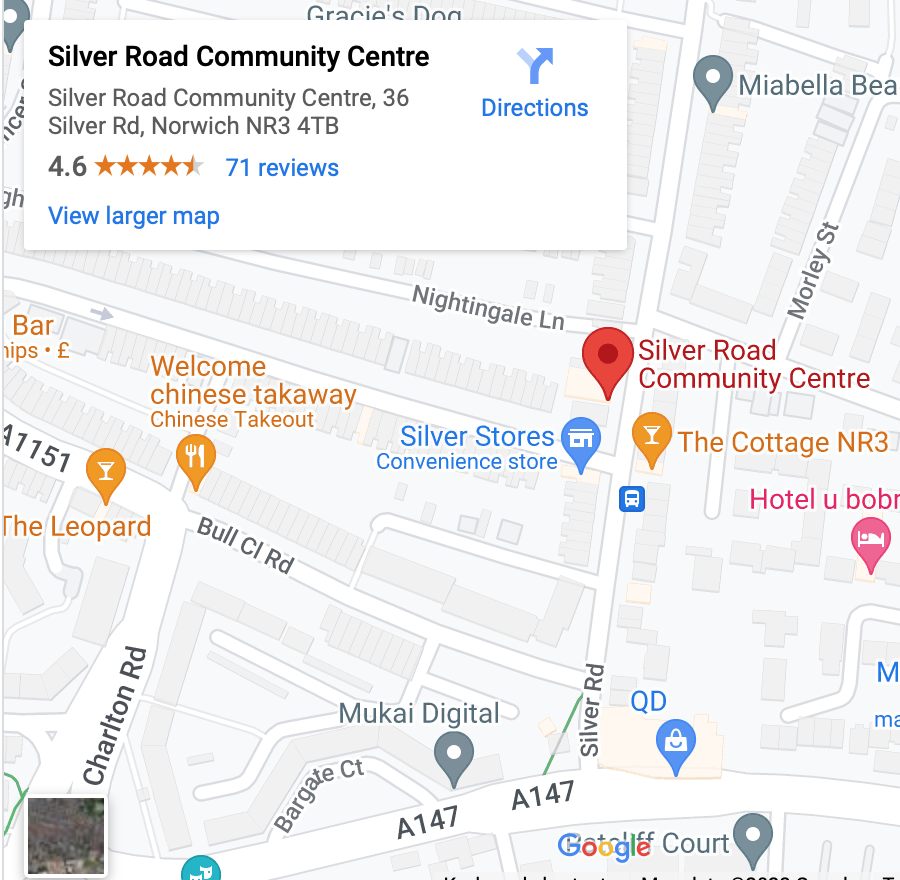
We are starting a new beginners Tai Chi class after Easter at the Silver Road Community Centre on Silver Road (the old Silver Rooms), beginning on Wednesday 26th April 2023. The class runs from 10am – 11:30am – please get there around 9:45am the first time you come.

There is some 2 hour free parking on Silver Road and Silver Street, but not much – you may have to go up to the top of the hill and park on Crome Road (near George White School), which is outside the controlled zone.

Classes cost £4 and you can pay-as-you-go. Existing students are welcome to come to this class as well.

You don’t need any special equipment or clothing. Some people change into a pair of light training shoes.

Xiwangmu, the Queen Mother of the West

西王母 Xiwangmu, the Queen Mother of the West, was the mother of the Weaving Maiden 織女 (zhi-nu). In older texts however, it is Xiwangmu herself who weaves. Wang-mu can also mean grandmother or ancestral mother; Xiwangmu is an ancient mother goddess. She lives in the far west on the mythical Mount Kunlun (after which a real mountain was later named). This mountain is an analogue to the Garden of the Hesperides of Greek mythology. Like the golden apples of the Hesperides, the peaches which grow on Xiwangmu’s sacred tree confer immortality, and are the gift of Xiwangmu. The Jizhingshu or “Bamboo annals” – an ancient chronicle of China which describes events up to 299 BCE tell how King Mu visited Xiwangmu on Mount Kunlun, where she made him immortal. Xiwangmu confers immortality.

In the image at left we see her riding a tiger. However, the Shan Hai Jing (“Classic of Mountains and Seas”), which dates to the 4th century BCE, describes her as having a human face but a tiger’s body and teeth, and a leopard’s tail – a fierce, shamanic figure. She is attended by fabulous creatures such as a nine-tailed fox and a three-legged crow.

The head-dress she wears is a 胜 sheng. Whilst the sheng was a common object in ancient China, only Xiwangmu is ever depicted wearing one: it is her “attribute” (just as St Peter is always depicted with the keys of heaven, or Saint Catherine with a broken wheel).

Sheng is also the horizontal axis of the old Chinese loom, around which the warp threads were wound – the oldest depictions of the head-dress show such an axis. Sheng thus marks Xiwangmu out as a weaver. She is a weaver of fate, like the three norns of Norse mythology: a cosmic weaver; the magpie (crow) is one of her familiars.

A woman wearing a 花胜 hua-sheng (flower sheng) in a Chinese costume drama

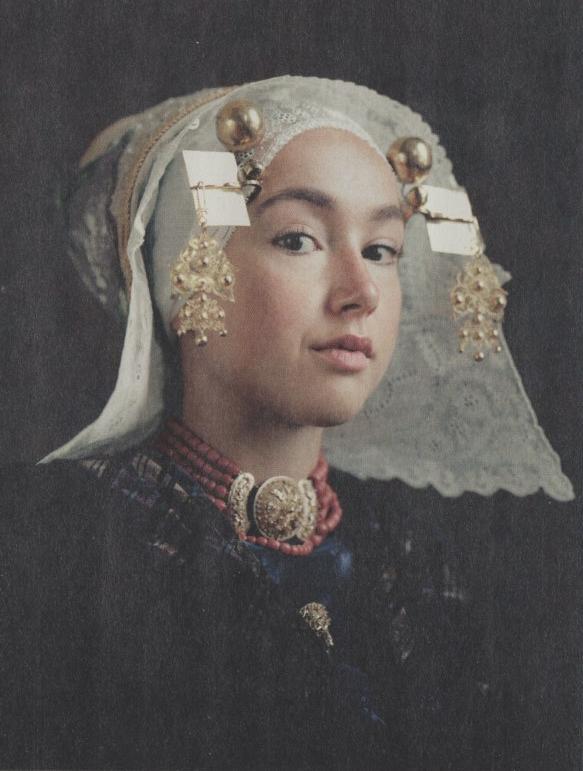
The connection of the head-dress with a loom seemed a bit far-fetched until I stumbled across this image of a Dutch girl in traditional dress in the KLM in-flight magazine. The form of the head-dress is far too particular to be purely decorative, and its resemblance to the sheng is very striking.

Laurelle, Zuid-Beveland NL – photo © Jimmy Nelson 2021

The text in the Shan Hai Jing is difficult to translate, but Xiwangmu controls constellations, including the “Grindstone” – a reference to the Pole Star, about which the sky turns. Her tree is thus a world tree, and she is its guardian.

Xiwangmu is also herself associated with the 7th day of the 7th month. A tale from the Western Jin period (266–316) tells how Xiwangmu visited the emperor who was on a quest for immortality. She took with her seven peaches, and gave five to the emperor. He ate them but kept the stones, which he wished to plant. Xiwangmu just laughed, telling him that the tree only bore fruit once every three thousand years. In these legends we see how the Weaving Maiden’s attributes as a weaver and her connection to the Festival of Sevens were originally aspects of her mother, who is a much older goddess.

You can read more about Xiwangmu in an excellent article on suppressed histories.

A modern image of Xiwangmu by 白树是我呀 showing her splendid sheng (head dress).

Just one thing

Dr Michael Moseley is well known as a TV presenter and more recently for his radio programme “Just One Thing”, which suggests simple things we can do to improve our health. In a recent episode, The surprising health benefits of Tai Chi, he explored Tai Chi! Dr Moseley looks at scientific evidence for the health benefits of Tai Chi and concludes that “Tai Chi can significantly enhance the activity of our immune system… [and] was as effective as conventional exercise for reducing body weight and visceral fat!”

The programmes are just 15 minutes long – which was also how long he asked his volunteer to practice for every day (students please note!). Listen to it on BBC sounds.