
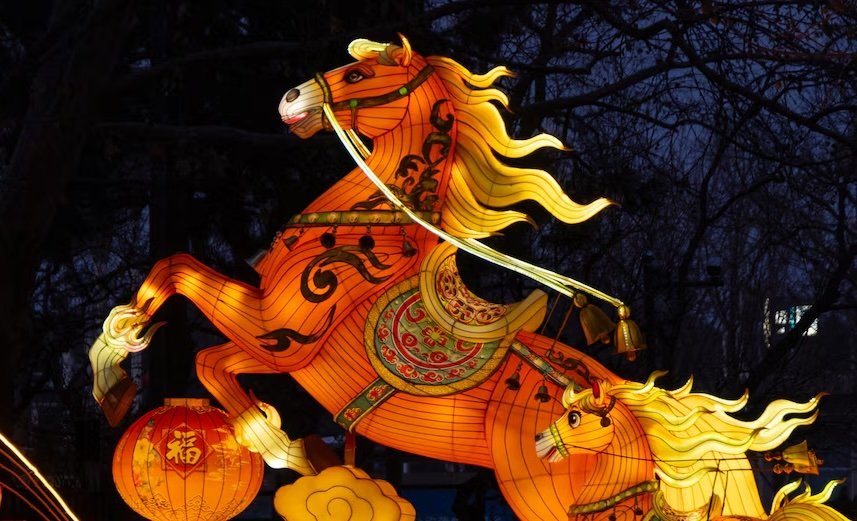
The Lunar New Year began on February 17th, 2026, and celebrates the year of the Fire Horse. The colour associated with fire is red, and there is a further legend about the “heavenly horses” – not mythical creatures, but real historical animals taken by the Han Chinese from the nomads of the Eurasian steppe – having a blood red colour. For this reason, this year is also known as the Red Horse Year 赤馬年. The year of the Fire Horse is an especially powerful year in which we can expect great dynamism and change, but not necessarily for the better. I am reminded of the famous line of Margot Channing (Bette Davis) in the film All About Eve (1950): Fasten your seat belts, it’s going to be a bumpy night.
What were the heavenly horses? To the North and West of the Chinese plains lies the Mongolian steppe, whose tribesmen harassed the Chinese. The Chinese called these tribes the Xiongnu; we know them as the Huns. The tribesmen were mounted on horses which, having evolved to cope with the mountainous terrain of the steppe, were larger and stronger than the horses native to the Chinese plains. To combat them the Chinese needed better warhorses.
During the Han dynasty (206 BCE–220 CE) the emperor sent expeditions to investigate and then to import the highly coveted “heavenly horses” () from the Central Asian kingdom of Ferghana in Uzbekistan. These expeditions were long, arduous and costly. The envoy sent to investigate the tribesmen’s horses spent ten years in remote jails before escaping and returning home. When the Chinese then sent an ambassador with a thousand gold pieces, the Ferghana refused to sell and the ambassador was executed, sparking a war which lasted several years. The Chinese eventually seized 3,000 horses. Most of these died on the long journey home, but enough survived to establish these horses in China. They immediately proved their worth in battle, giving rise to the Chinese saying 馬到成功 : Horses arrive, instant success.
Those born in the Year of the Horse (1930, 1942, 1954, 1966, 1978, 1990, 2002, and 2014) are said to be intelligent, strong, and energetic with an outgoing nature. They enjoy interacting with others and are good at multi-tasking, although they rarely finish projects because they’re off to the next one before they finish the last. Typically they have money issues, and when it comes to matters of the heart, they fall hard and fast.
Horses are heroic creatures in Chinese mythology, capable and loyal. In the classic novel The Journey to the West, known in the west from it’s television adaption as Monkey, the horse belonging to the monk Tripitaka, White Dragon Horse, is one of the main characters, and becomes a Bodhisattva (enlightened being) at the end of the tale thanks to his endurance and perseverance. In China, the combination of the spirit ( 精神) of the dragon () with that of the horse () is thought to be particularly useful, giving rise to the idiom 龙马精神 .
The Chinese also have a legend of the or Thousand Li Horse, capable of travelling 1000 li (just over 250 miles) in a single day. Today, qianliama is a metaphor for an extremely capable person.
The Fire Horse
Fire Horses are thought to be particularly strong willed, the fire element amplifying the horse’s natural qualities of enthusiasm and leadership. The “phase” of fire is associated with the colour red, and the Fire Horse Year is also called 赤 馬 年 Red Horse Year.
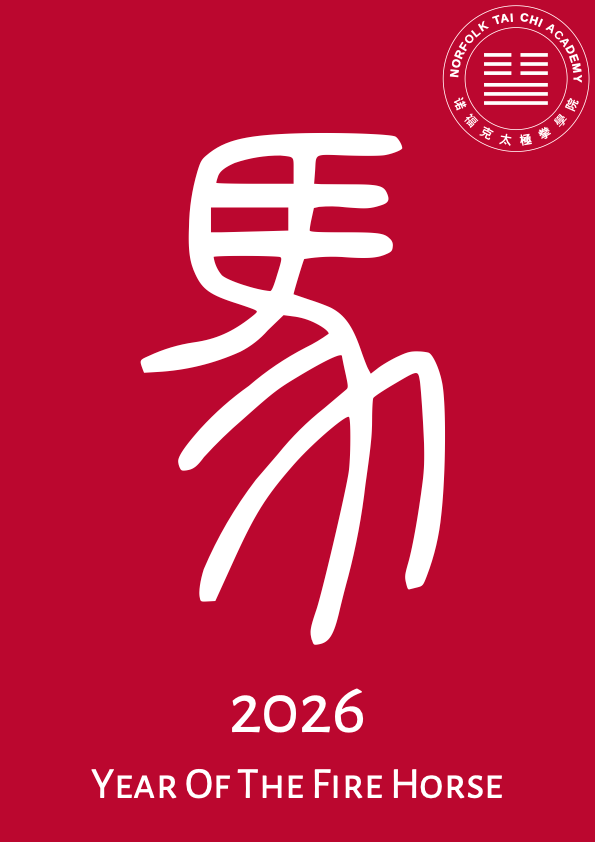
The Horse in the Taoist Arts
In an earlier article we spoke about the Tai Chi move Wild Horse Parts Mane, but the horse also shows up in the Taiji Sword set and in the Lok Hup set.
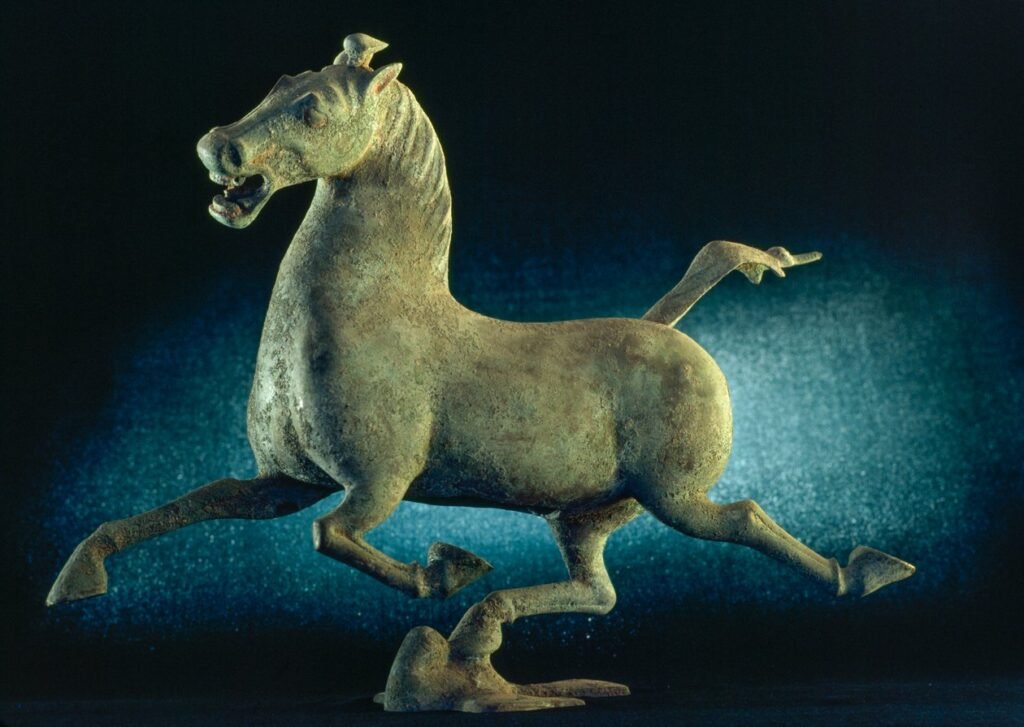
In the Taiji sword set, Move 28 is 天馬行空 – Heavenly Horse Flies through the Sky. Heavenly Horse refers to the warhorses captured from the kingdom of Ferghana, as we explained above, and should not be interpreted as a reference to a literal flying horse such as the greek legend of Pegasus.
In Lok Hup, a long sequence in the second part begins with move 48 走馬觀花 Moving Rider Looks at Flowers. In this movement we look down as if from horseback, but the phrase also turns out to be a metaphor for seeing things fleetingly and thus superficially, just as a galloping rider can only glance at the scenery as it passes by.