
In a move such as Repulse Monkey (Step Back to Ward-off Monkey) we do not simply fall backwards. Yes we step back, but we do so to Ward off the Monkey in front of us. In other words, as we step back there is an intention (意 ) forwards.
Less obvious is that in order to go forwards we need a backwards intention. As we transfer the weight forward, the back foot roots – there is an intention down the back leg into the heel. But this intention is created earlier, as we sit (in order to make the empty step), manifesting in the tail bone. In Tai Chi it has been said 向前有後意 – Going Forward with Backward Intention.
These opposite directions create stretch which is a huge component of Mr Moy’s Tai Chi. The stretch engages the tendons and helps to generate elastic force (彈勁 ), meaning the refined, skilful (功 ) power cultivated by Taiji practice, as opposed to brute force (力 ).
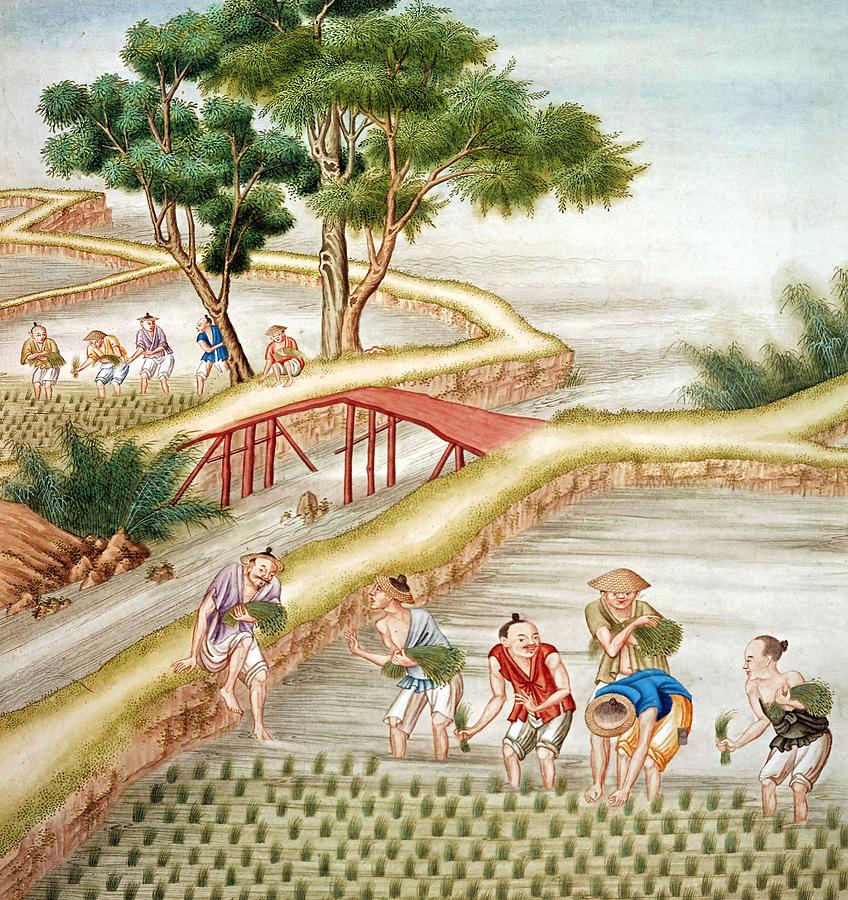
Another occasion when people step back in order to achieve something is when planting rice. One can see this for example in the final scene of Kurosawa’s film Seven Samurai. The planter steps back into the empty part of the rice paddy in order to plant the next seedling. In China, the cultivation of a field is often a metaphor for self-cultivation and the Chinese monk Budai (“Cloth Sack”) (real name 契此 (Qici) wrote this poem in the early 10th Century (the Five Dynasties period):
Planting green rice seedlings in the wild field, one can see the sky reflected in the water when looking down.
Only when the six senses are purified can one truly benefit from rice; taking a step back is actually moving forward.
手把青秧插野田,低头便见水中天
六根清净方为稻,退步原来是向前